






Economy Policy
Global governance stagnates, with backsliding more common than progress: ILO report







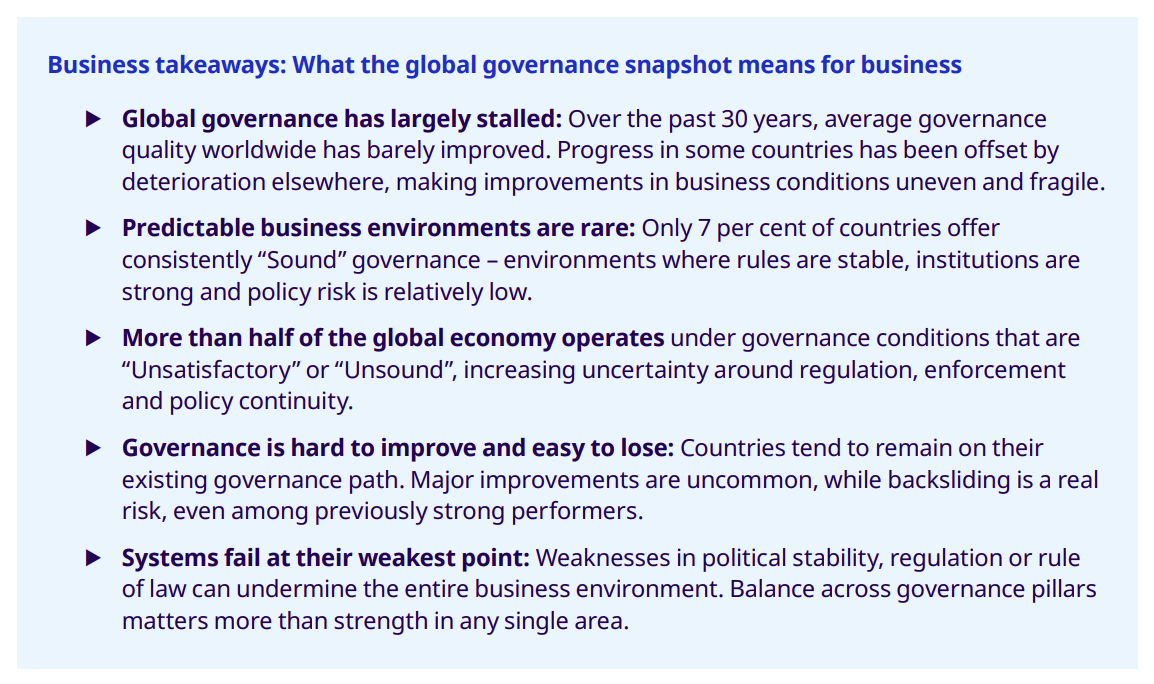
One of the report’s most striking findings is that governance is easier to lose than to build, and political governance, including accountability, stability, and checks on executive power, emerges as the most vulnerable dimension.
Global governance has shown little improvement over nearly three decades, with setbacks outpacing gains and more than half of the world’s economies operating in conditions that create uncertainty for business and investment, according to a new report by the International Labour Organisation (ILO).
The study, produced by the ILO’s Bureau for Employers’ Activities, analyses governance trends across 208 economies between 1996 and 2024. It finds that despite ongoing reform efforts, overall governance performance has remained largely unchanged, reflecting a pattern of incremental progress offset by frequent declines.
A fragmented global landscape
The report paints a stark picture of uneven governance conditions worldwide. Only 7.2% of economies qualify as operating in “sound” governance environments, marked by strong institutions, stability, and predictability. In contrast, 52.9% face governance conditions that heighten uncertainty for businesses and investors.
While a modest share of countries fall into a “satisfactory” category, a significant proportion continue to grapple with institutional and regulatory weaknesses. At the extreme end, a small but critical group of countries faces severe governance breakdowns, where instability, weak institutions, and conflict make economic activity highly risky.
Overall, global governance scores have remained broadly flat since the mid-1990s, underscoring what the report calls a “world of stagnation.”
Decline more likely than progress
One of the report’s most striking findings is that governance is easier to lose than to build. Countries that demonstrated strong governance decades ago largely remain ahead, while those with weaker systems have struggled to catch up.
However, when change does occur, it is more likely to be negative than positive. Nearly one-third of top-performing countries experienced a decline in rankings over time.
Political governance, including accountability, stability, and checks on executive power, emerges as the most vulnerable dimension. While regulatory and institutional improvements can be built gradually, political systems are more prone to erosion, particularly amid rising polarisation and weakening oversight.
This dynamic, the report notes, highlights the need to actively protect governance gains rather than assume they will endure.
Direct link to investment flows
The findings also reinforce a strong connection between governance quality and a country’s ability to attract foreign direct investment (FDI).
Countries with stable, predictable governance environments consistently attract higher levels of investment, even when accounting for other factors such as market size, infrastructure, and macroeconomic conditions.
Governance, the report argues, acts as a foundational enabler, determining whether broader economic advantages can translate into sustained investment and job creation.
Employers’ organisations face capacity gap
Beyond national systems, the report examines the role of employer and business membership organisations (EBMOs) within governance ecosystems.
While many such organisations have achieved formal independence from governments, a majority lack the capacity to translate that independence into effective policy influence. This gap is particularly pronounced in developing and emerging economies, where more than 83% of organisations report limited operational capacity.
The report stresses that strengthening internal governance and institutional capacity is critical, not only for amplifying business voices but also for sustaining reform momentum over time.
Governance reform requires long-term commitment
The report concludes that governance reform is inherently slow, complex, and fragile. Rather than a short-term policy lever, governance is shaped by deep institutional structures, political incentives, and historical trajectories.
It outlines three core principles for effective reform: prioritising the weakest governance pillar, extending reform timelines, and establishing safeguards to prevent backsliding.
“Governance underpins sustainable enterprises, decent work, and inclusive growth. Building strong institutions requires time and commitment, and progress can be fragile. Employers’ organisations play a key role by both advocating for and embodying good governance,” said Deborah France-Massin, Director of the ILO Bureau for Employers’ Activities.
The report reinforces the ILO’s longstanding position that resilient labour markets and inclusive growth depend on strong institutions and accountable governance. It calls for renewed collaboration among governments, employers, and workers to strengthen the systems that support sustainable economic development.
Persistent gaps, limited convergence
Long-term data shows that governance performance remains deeply entrenched. Countries that rank highly today, such as Finland, Denmark, and New Zealand, have maintained strong governance across decades, while those at the bottom continue to struggle with structural weaknesses.
This persistence underscores a key message for policymakers and business leaders alike: governance is not easily transformed, and without sustained effort, progress can quickly unravel.
For businesses, the implication is clear, stability and credibility matter as much as current conditions. In a global environment marked by uneven governance and frequent reversals, long-term investment decisions increasingly hinge on the durability of institutional frameworks, not just short-term reform signals.
Topics
Author
Loading...
Loading...