






Economy Policy
Qatar positions labour reforms as model for global migration governance






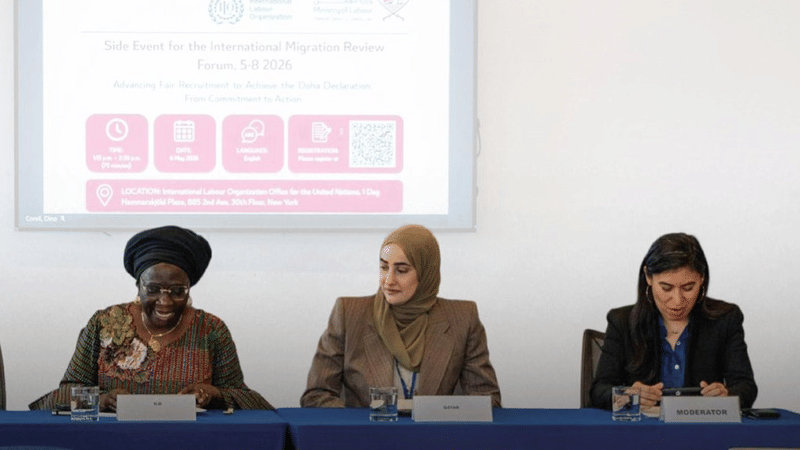
Highlighting its own reform journey, Qatar outlined a series of labour market changes introduced in recent years, including the abolition of exit permit requirements and greater flexibility for workers to change employers.
The State of Qatar reaffirmed its commitment to building an integrated labour and migration governance system, positioning its labour reforms as a practical model for balancing economic competitiveness with migrant worker protections, at the Second International Migration Review Forum in New York.
Delivering Qatar’s statement, Sheikha Najwa bint Abdulrahman Al-Thani, Undersecretary of the Ministry of Labour, urged the international community to prioritise three core areas to shape the future of migration governance: expanding regular migration pathways, embedding worker protections across the migration cycle, and strengthening accountability through measurable monitoring systems.
Qatar argued that regular migration pathways should be viewed not merely as responses to irregular migration, but as strategic policy tools capable of helping countries adapt to the changing realities of climate change and technological disruption in global labour markets.
The country also stressed the need for a shared international framework that integrates labour, residency, and anti-trafficking policies while ensuring protections begin in countries of origin and continue through reintegration upon return.
Highlighting its own reform journey, Qatar outlined a series of labour market changes introduced in recent years, including the abolition of exit permit requirements and greater flexibility for workers to change employers. The country also pointed to the introduction of the region’s first non-discriminatory minimum wage, alongside the establishment of visa centres in workers’ home countries aimed at strengthening protections before migration begins.
Qatar said these reforms are backed by enhanced complaint mechanisms, legal accountability measures, and stricter enforcement systems designed to ensure labour protections translate into practice.
The government further emphasised that human trafficking requires a coordinated response, noting that Qatar has developed an integrated governance framework linking labour, migration, residency, law enforcement, and anti-trafficking policies into a unified system.
According to the statement, the reforms now impact more than two million individuals daily, with Qatar describing itself as having evolved into a “practical point of reference” within the framework of the Global Compact for Migration.
Beyond the plenary discussions, Sheikha Najwa held bilateral meetings with senior officials from Lesotho and Somalia to discuss cooperation in labour relations and migration governance.
Qatar also took a leading role in multiple side events held alongside the Forum, including discussions on fair recruitment practices and combating migrant worker exploitation and human trafficking.
Speaking at the event titled “Advancing Fair Recruitment to Achieve the Doha Declaration: From Commitment to Action,” Sheikha Najwa said the international community must move beyond “perfunctory declarations” towards measurable implementation and stronger institutional cooperation.
She described fair recruitment as a fundamental pillar for protecting human dignity, stabilising labour relations, and reducing vulnerabilities to exploitation. Qatar’s policy framework, she noted, includes stricter recruitment regulation, greater contractual transparency, expanded legal protections, and improved access to justice for workers.
In another high-level session co-hosted with Uzbekistan, Qatar highlighted the importance of integrating institutional frameworks and community partnerships to protect migrant workers from exploitation and trafficking.
The discussions focused on strengthening victim protection systems, improving coordination between labour-sending and labour-receiving countries, and expanding support services including safe accommodation, healthcare, legal aid, and psychosocial support.
Concluding its intervention, Qatar reiterated that labour reforms are driven not by external pressure, but by the belief that investing in human rights is essential for long-term economic resilience and social stability.
Topics
Author
Loading...
Loading...