






Economy Policy
Saudi Arabia reinforces equal opportunity agenda with national workplace policy







The policy underscores protecting workers’ rights, ensuring equal pay for equal value, and strengthening social protection for evolving work models, and for employers to move workforce inclusion and fair treatment from compliance obligations to strategic imperatives.
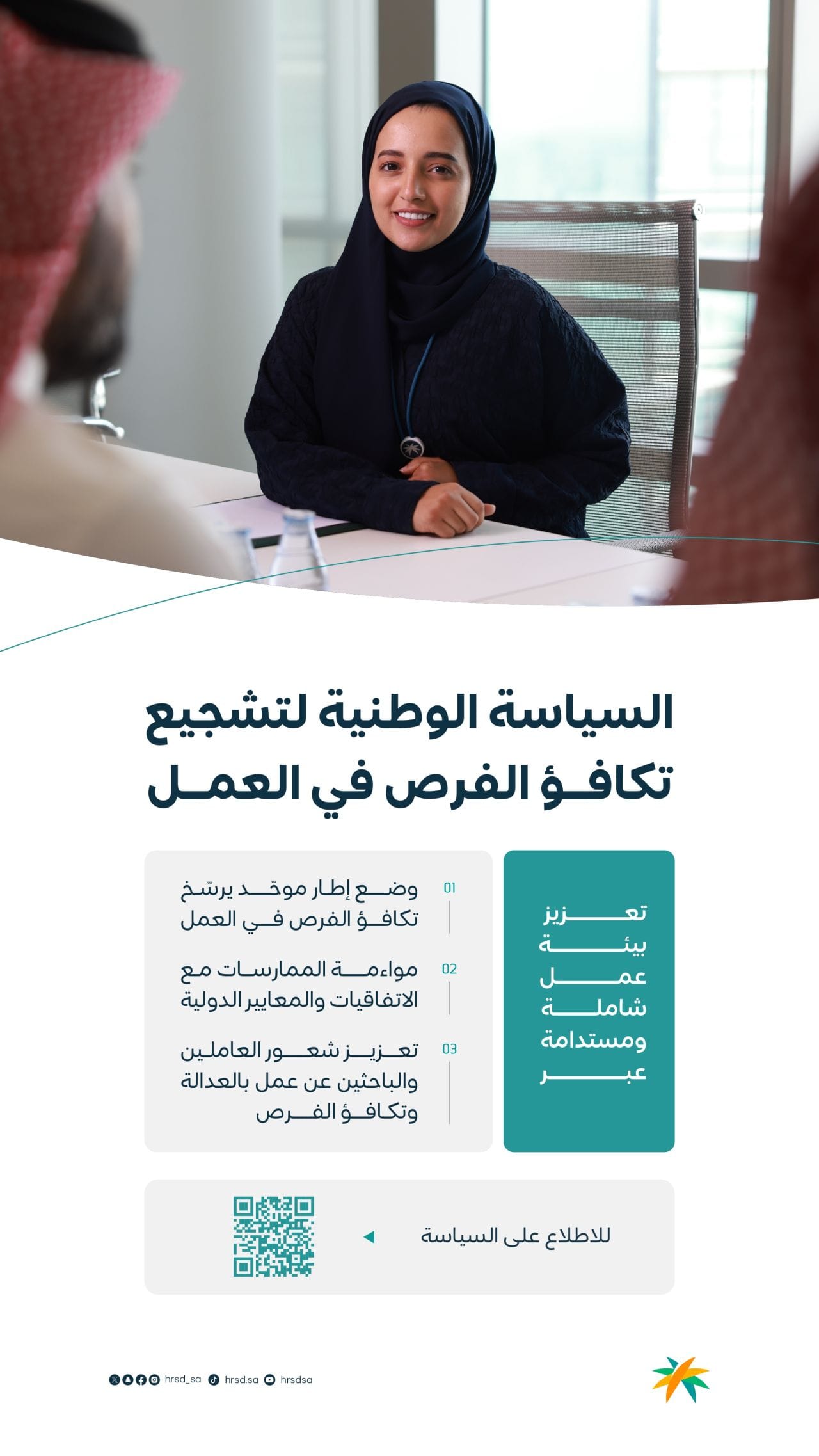
Saudi Arabia has formalised its commitment to fair and inclusive workplaces through the National Policy for Promoting Equal Opportunities and Equality of Treatment in Employment and Occupation, positioning equity as a central pillar of its social and economic development strategy.
"The National Policy to Promote Equal Opportunities and Equality of Treatment in Employment and Occupation in the Kingdom of Saudi Arabia reflects the Kingdom’s commitment to making equal opportunity and equality of treatment in employment and occupation two fundamental pillars of the Kingdom’s future social and economic development. This commitment was expressed through the approval of the policy pursuant to Council of Ministers Resolution No. (416) dated 11/6/1444 AH," the Ministry said in the announcement.
The policy establishes a comprehensive national framework to eliminate discrimination in employment and strengthen workforce participation, particularly among women and underrepresented groups, in line with Vision 2030 goals.
The policy defines discrimination broadly as any distinction or exclusion based on factors such as race, colour, gender, national or social origin, disability, or age, whether direct or indirect.
At the same time, it clarifies that job-related qualification requirements and nationality-based distinctions permitted by law do not constitute discrimination.
Focus on systems, participation and enforcement
The framework outlines three core priorities.
First, it calls for strengthening labour and civil service regulations to prevent discriminatory practices and ensure equality across hiring, pay, promotion, training, and working conditions. Authorities will also introduce stronger grievance and remedy mechanisms and conduct periodic legislative reviews.
Second, the policy seeks to boost labour market participation among women and groups with fewer opportunities. Planned measures include reviewing existing empowerment programmes, expanding social awareness efforts, supporting school-to-work transitions through targeted training, and enabling workforce re-entry after career breaks.
Third, the Ministry of Human Resources and Social Development will oversee implementation through enhanced monitoring, evaluation, and reporting systems. The ministry will coordinate with relevant entities to establish effective complaint channels and is expected to set up an Equal Opportunities Unit to drive execution.
Strategic workforce shift
The policy also highlights the importance of protecting workers’ rights, advancing equal pay for work of equal value, and strengthening social protection systems to keep pace with evolving work models.
For employers, this means workforce inclusion and fair treatment are moving from compliance requirements to strategic imperatives. As Saudi Arabia advances its Vision 2030 agenda, the success of the policy will likely hinge on how effectively organisations translate the framework into measurable workplace practices.
Author
Loading...
Loading...